
Technological Offers
Protein to treat growth disorders and bone density.
Description
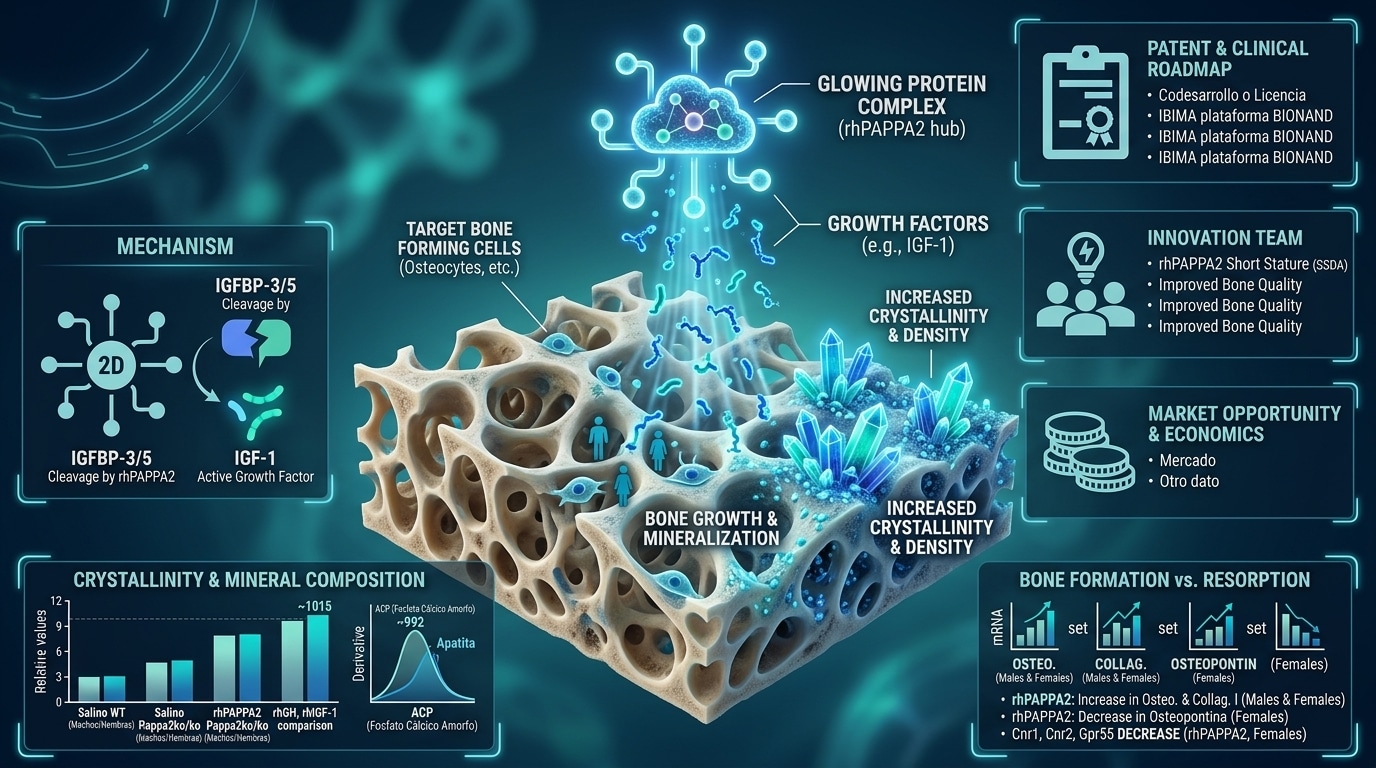
Administration of the recombinant human protein rhPAPPA2 to cleave the binding proteins IGFBP-3 and IGFBP-5.
It selectively increases the local release and bioactivity of free IGF-1 in skeletal target tissues.
It modulates bone remodeling by stimulating matrix formation and regulating the endocannabinoid system in bone.
Medical need
Growth disorders due to mutations in the PAPPA2 gene PAPPA2 limit the tissue bioavailability of free IGF-1 factor.
Patients suffer from postnatal growth retardation, short Dauber-Argente stature (SSDA) and alteration of bone mineralization.
Current therapies fail to fully restore bone quality and skeletal microarchitecture.
Applications
Therapy to mutations in the PAPPA2 gene disorders.
Prevalence
Paediatric patients carrying homozygous or missense mutations in the PAPPA2 gene.
<1 / 1,000,000 inhabitants
Market
Global Market: Valuing at USD 8,500 – 9,000 million in 2026.
Pediatric Segment: Accounts for about 60% of the total market
Other solutions
Growth hormone or recombinant IGF-1, with limited efficacy in restoring bone quality and density.
Results
It significantly increased markers of bone formation (osteocalcin and collagen I) in in vivo models.
It decreased markers of resorption (osteopontin) and elevated expression of cannabinoid receptors (Cnr1, Cnr2, Gpr55).
It reversed compositional alterations, increasing amorphous calcium phosphate and restoring matrix mineralization.
Diagnosis
Therapy
IBIMA Plataforma BIONAND inventors
JUAN SUÁREZ PÉREZ
Research group of IBIMA involved: C-06
MAR FERNÁNDEZ ARJONA
Research group of IBIMA involved: C-01
ANTONIO JESÚS LÓPEZ GAMBERO
Research group of IBIMA involved: C-06
FERNANDO RODRÍGUEZ DE FONSECA
Research group of IBIMA involved: C-06
PATRICIA RIVERA GONZÁLEZ
Research group of IBIMA involved: C-06